
Half of the world could have Myopia by 2050
Myopia or near-sightedness is very common. It happens when the eye grows too long or the cornea is too curved, causing light to focus in front of the retina rather than directly on it. This then results in blurry distance vision while near vision remains clear. Myopia has grown a lot in recent decades, mainly in East Asia with experts predicting that nearly half the world's people to have it by 2050. This piece reviews current rates and causes.
Global Myopia Rates
The World Health Organization (WHO) shows that myopia and severe near-sightedness are big public health issues. In 2020 about 2.6 billion people had myopia and around 400 million had severe cases of it. Rates rise mostly in children and teenagers. A 2016 study in Ophthalmology estimated that by 2050, almost 50% of people (~ five billion) will have myopia, with close to 1 billion suffering with severe forms of the condition. The study ties this to lifestyle shifts like more digital screen use, extended near tasks along with fewer outdoor hours.
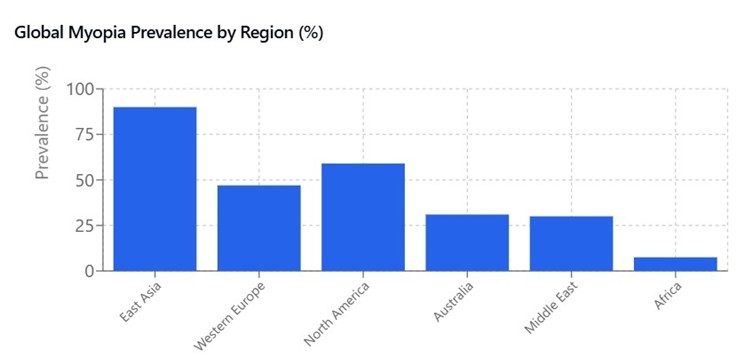
Myopia Rates by Region
East Asia
East Asia shows the highest myopia rates, especially in young people. Research finds that nearly 80-90% of teenagers in South Korea, China, Japan, Singapore get myopia before finishing high school. In China, up to 95% of university students show myopia.
A 2019 survey by the Chinese National Health Commission found that a whopping 53.6% of schoolchildren had myopia, with 81% of high school students affected.
A 2013 survey found 96.5% of 19-year-old males in South Korea were myopic, one of the highest rates ever known.
And in Singapore, an estimated 83% of young adults have myopia.
Europe
Europe has lower myopia rates than East Asia with roughly 30-40% of adults having myopia, with higher levels seen in the younger groups.
A JAMA Ophthalmology study noted 47% of young adults (25-29) had myopia, versus only 30% in people above 60 years of age.
Northern Europe has lower numbers, with Denmark and Norway at about 25 to 30%.
In the United Kingdom, about 15% of children aged 12 to 13 now have myopia. Studies also show that every extra hour of daily screen time is associated with an increase of 21% in terms of a child's chance of having myopia. For example, four hours of screen use each day lift rates from 15% to 27%.
The COVID-19 pandemic also changed myopia numbers quite rapidly. Research says more screen time with less outdoor play during lockdown played a role in more children getting myopia. For instance in Scotland, preschool diagnoses of myopia climbed 42% after the pandemic compared to before.
North America
Myopia has risen over the past decades in North America. According to the National Eye Institute (NEI), 25% of Americans had myopia in the 1970s, a figure that has climbed to nearly 42% recently.
The NEI shows young people are more affected with 59% of those aged 25-29 showing myopia versus only 20% above 65 years of age.
Severe myopia puts eyes at risk for detachment and degeneration, which now affects 5-10% of Americans.
Australia and Oceania
Australia shows a rising trend but still remains below East Asian levels. A study by the Brien Holden Vision Institute found out that 31% of Australian adults have myopia, with this number expected to be 50% by 2050.
Among 17-year-olds, 31% have myopia, which is an increase from 14% in the 1970s.
More screen time and fewer outdoor hours will only boost these numbers further.
Africa and the Middle East
Africa has much lower myopia numbers: 5-10%. Yet urban changes and modern habits have lifted rates in some places.
In the Middle East, young adult myopia ranges from 20% to 40%, with countries like Israel and the UAE showing rising trends.
Myopia-Causing Factors
Genetics
Those with myopic parents face a higher chance of getting myopia. Research ties genetics to between 50% and 60% of cases.
Close-Up Tasks
Extended reading and studying on a digital screen is linked to myopia. One study found children who spent more than 3 hours close up to a screen were at a higher risk of myopia.
Limited Outdoor Time
Outdoor time helps slow down myopia. Research shows that children with 2 or more outdoor hours a day lower their risk of myopia by 30%.
Urban Living and Modern Habits
City life with high school pressures and heavy screen use results in higher myopia than rural settings.
Conclusion
Myopia grows worldwide. East Asia shows the worst rise. As numbers climb in younger people, public strategies need to be implemented to curb this rise. More outdoor time, reduced screen use and new treatments may ease this global issue.
Sources:
https://www.who.int/news-room/fact-sheets/detail/b...
https://www.aaojournal.org/article/S0161-6420%2816...
https://pmc.ncbi.nlm.nih.gov/articles/PMC7738137/
https://jamanetwork.com/journals/jamaophthalmology...
https://www.theguardian.com/society/2025/feb/21/ev...
https://www.thetimes.com/uk/scotland/article/child...
https://www.nei.nih.gov/about/news-and-events/news...
https://brienholdenfoundation.org/news/half-the-wo...
https://www.mykidsvision.org/knowledge-centre/scre...